A Canadian job offer can be an exciting turning point. It can also raise a surprisingly difficult question: Does the employer need a Labour Market Impact Assessment before you can work in Canada? The answer depends on the type of work authorization, the nature of the job, the applicant’s circumstances and the rules governing the employer. There is no single work permit process that fits every international hire.
In 2026, the distinction matters even more because changes to Express Entry job-offer scoring have attracted attention. Those changes do not eliminate LMIA requirements across Canada’s temporary work permit system. Before making relocation plans, an applicant and employer need to know which legal pathway they are actually using.
This guide explains the practical difference between LMIA-supported and LMIA-exempt work permits, what an open work permit means, and when a Canada work permit lawyer can help prevent avoidable setbacks.
Start with the type of Canadian work permit
Canada broadly distinguishes between employer-specific work permits and open work permits. An employer-specific permit usually restricts the holder to the employer, occupation, location or other conditions shown on the document. An open work permit generally allows work for a range of eligible Canadian employers, subject to restrictions printed on the permit and program-specific rules.
Neither type should be confused with a visitor visa or authorization to enter Canada. Permission to travel and permission to work are different things. In most situations, a person who needs a work permit must obtain the correct authorization before beginning employment.
An employer-specific permit may require a Labour Market Impact Assessment (LMIA), but some employer-specific permits are issued under LMIA-exempt categories. An open work permit normally does not require a job offer or LMIA, yet applicants must still qualify under a specific program or public policy. It is not a permit that anyone can request simply because they want to work in Canada.
For an overview of the different routes Konan Law handles, see its temporary residence services.
What is an LMIA, and when is one needed?
An LMIA is an assessment generally issued by Employment and Social Development Canada (ESDC) to evaluate the impact that hiring a foreign worker may have on the Canadian labour market. For many positions under the Temporary Foreign Worker Program, the employer must obtain a positive LMIA before the foreign worker can use that approval to support an employer-specific work permit application.
The employer, not the prospective employee, is responsible for the LMIA process. Applicable requirements may involve advertising and recruitment, wages, business legitimacy, fees, and compliance with federal rules. Exact steps vary by stream, job and location. A positive LMIA does not, on its own, guarantee a work permit: IRCC still assesses the individual applicant for admissibility and the conditions of entry.
A practical example is an employer in Canada recruiting a specialist from overseas for a role that is not covered by an LMIA exemption. In that case, the employer may need to complete the appropriate LMIA process first. The candidate then applies for the work permit with the required employment information and personal documentation.
Konan Law has a dedicated page on LMIA work permits, which can help prospective applicants identify the services relevant to this route.
What does LMIA-exempt actually mean?
An LMIA exemption means the employer does not need to obtain an LMIA for a particular qualifying work permit category. It does not mean there are no eligibility requirements, no employer responsibilities or no immigration scrutiny. Many LMIA-exempt employer-specific permits fall within Canada’s International Mobility Program, where the rationale for authorization differs from a conventional labour-market assessment.
Depending on the category, the employer may need to submit an offer of employment through IRCC’s Employer Portal, provide an offer number and pay an employer compliance fee unless an exemption applies. The worker may have to demonstrate how the job, personal qualifications and employer circumstances satisfy the relevant exemption code.
Examples can include eligible intra-company transferees, certain international-agreement categories and some workers whose entry is expected to provide a significant benefit to Canada. The specific requirements differ considerably. A job title alone is rarely enough to establish an exemption, and an employer cannot simply decide to describe a position as “LMIA-exempt.”
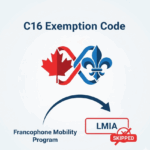
French-speaking workers may also have a route under the Francophone Mobility provisions when the applicable language, employment and geographic conditions are met. That option should be assessed on its own criteria, not treated as an automatic exemption for every French-speaking applicant.
Konan Law’s LMIA-exempt work permit services are a relevant internal resource for readers considering these categories.
Can you work in Canada without an employer-specific permit?
Some individuals qualify for an open work permit. Depending on current IRCC policies, examples may include certain graduates, eligible spouses or partners, and applicants in particular immigration situations. These are conditional pathways rather than universal entitlements. Spousal open work permit eligibility, in particular, has undergone restrictions and adjustments in recent years, so older blog articles should not be used as the final authority.
Open permits can provide flexibility because a change of employer may not require a new employer-specific permit, provided the work complies with the permit’s terms. However, an open permit holder must still observe any occupational or other restrictions appearing on the document and any rules attached to their immigration status.
If you have heard that a spouse of a student or foreign worker can “always” obtain an open work permit, pause before relying on that advice. Whether the spouse qualifies can depend on the principal applicant’s program, occupation, permit validity, and other details. The correct analysis uses the current IRCC category rules.
Readers can learn more about this service through Konan Law’s open work permit page.
Does the November 2026 Express Entry change remove the LMIA for work permits?
No. This is one of the most consequential distinctions for applicants and employers to understand. As of November 3, 2026, IRCC changed how qualifying job offers are recognized in the Express Entry permanent residence system. An LMIA is no longer required for relevant Express Entry job-offer eligibility and CRS point assessments, subject to the updated requirements.
That does not mean an applicant can obtain an employer-specific temporary work permit without an LMIA whenever a Canadian company offers a job. The temporary work authorization must still be based on its own legal category: LMIA-supported, LMIA-exempt, open permit, or another applicable authorization.
Consider a person offered a professional role in Canada. The offer might meet the new Express Entry criteria for points, but if the person wants to start working next month, the employer and candidate must separately determine what temporary work permit route is legally available. Permanent residence planning and short-term employment authorization sometimes interact, but they should never be treated as interchangeable.
What documents are commonly needed for a work permit application?
Document requirements depend on the permit type and where the applicant applies. For an employer-specific application, the package commonly includes a passport, evidence of qualifications and relevant experience, an employment contract or offer, and either LMIA-related information or the documents required under the applicable exemption. Applicants may also need biometrics, medical examinations, police or other documents depending on their situation.
What matters is the consistency of the application. Job duties should correspond to the claimed occupational classification. Employment dates should match reference letters and résumés. A role described as senior management in one document should not appear as entry-level support work in another. Where experience or education is needed to establish eligibility, supporting evidence should show how the applicant meets the actual requirement.
Applicants applying from inside Canada must also check whether they are eligible to use an inside-Canada process. Having visitor status does not automatically provide an unrestricted right to apply for every work permit from within Canada or to start working while an application is pending.
Common mistakes that can delay a Canadian work permit
One frequent problem is choosing a pathway based on a memorable label instead of its current legal criteria. Another is assuming an LMIA-exempt case involves no employer compliance steps. Employers sometimes underestimate the need to provide accurate offer information, while applicants may misunderstand how the permit limits their employment after arrival.
A third problem is overlooking timing. An employer may set a proposed start date before the immigration documents can realistically be completed. Because processing times vary, a responsible plan considers recruitment steps, eligibility checks and application preparation early in the hiring process. Working before receiving required authorization can create serious immigration consequences.
Finally, avoid relying on a generic checklist copied from another applicant. Two people with the same occupation may need different evidence if their nationalities, current status, employer structures or application locations differ. A good application explains a coherent individual situation rather than simply assembling a large folder of documents.
How to choose between the LMIA and LMIA-exempt routes
Begin with the actual proposed employment: employer, duties, location, salary, duration and expected start date. Determine whether a specific LMIA exemption applies. If it does not, the employer should assess whether an LMIA-supported route is available and commercially realistic. If the candidate may qualify for an open work permit, evaluate that possibility separately rather than assuming employer sponsorship is necessary.
It is equally important to ask what the applicant wants after the temporary assignment. Some workers plan to return home; others hope to pursue permanent residence. The latter may benefit from coordinating their work permit strategy with Express Entry or another immigration program, while recognizing that a temporary work permit does not guarantee permanent residence.
This is where individualized legal advice can create value. An experienced Canada work permit lawyer can review the proposed role, the employer’s supporting documents and the applicant’s immigration history to identify the correct category and foreseeable obstacles.
Konan Immigration Law Firm advises individuals and businesses on Canadian temporary residence and work authorization. To discuss an LMIA-supported permit, an LMIA-exempt option or a broader immigration plan, schedule a consultation with Konan Law. Clear decisions at the beginning can save substantial time and uncertainty later.